
Ravana: The Complex Antagonist of the Ramayana
16 July 2026
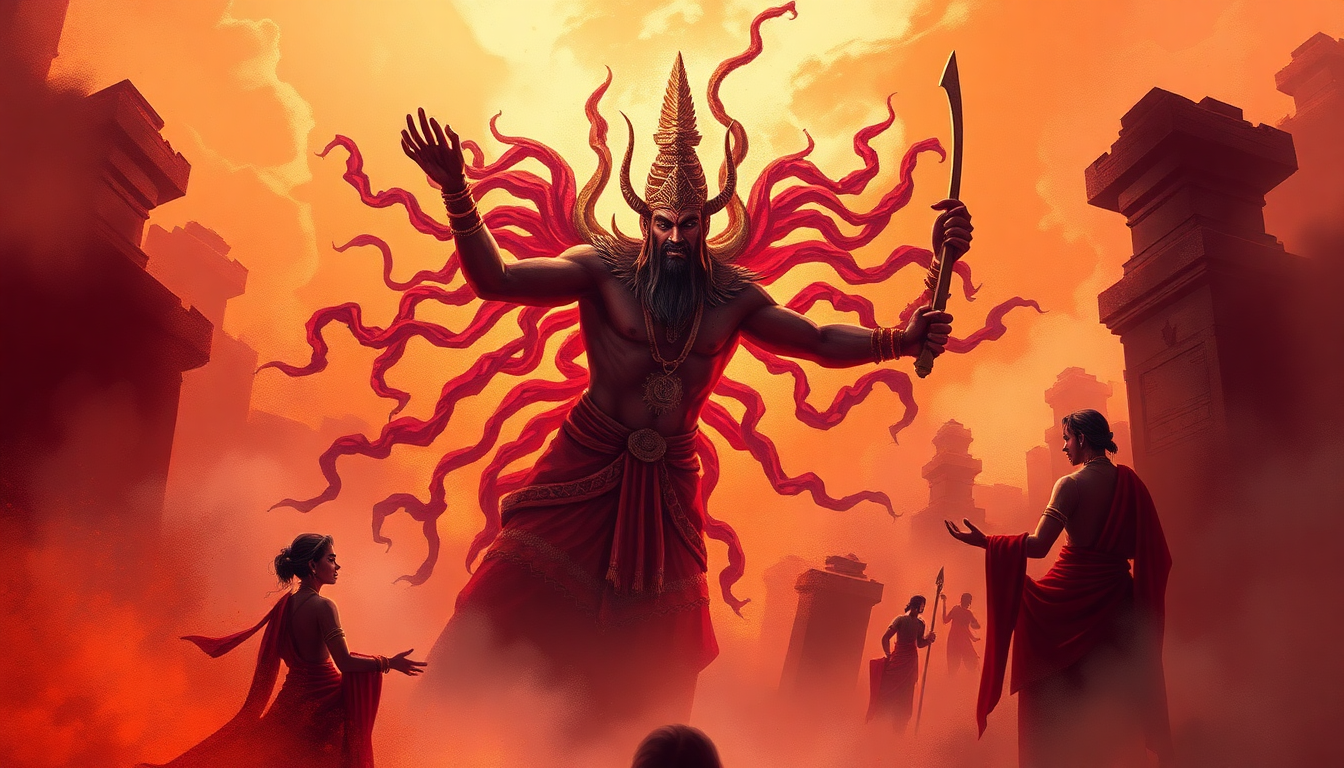
Ravana, the ten-headed king of Lanka, is one of the most compelling figures in Hindu mythology, particularly in the epic narrative of the Ramayana. While he is often portrayed as the quintessential villain due to his abduction of Sita, the wife of Lord Rama, a closer examination reveals a character steeped in complexity, scholarship, and profound power. His story is not merely one of evil deeds but rather a tapestry woven with threads of ambition, devotion, and tragic flaws.
Born to the sage Vishrava and a rakshasi named Kaikesi, Ravana was endowed with remarkable intellect and formidable strength from a young age. He was a master of the Vedas and other ancient scriptures, showcasing a deep understanding of philosophy, music, and the arts. His scholarly pursuits were not limited to mere academic excellence; they were a reflection of his desire to gain knowledge and power. This thirst for wisdom led him to perform intense penance, ultimately earning the favor of Brahma, the creator god, who granted him boons that made him nearly invincible. With these powers, Ravana sought to establish his reign over the three worlds, demonstrating his ambition and capability as a ruler.
However, Ravana's quest for dominance took a dark turn when he decided to abduct Sita. This pivotal act was not simply a manifestation of lust or evil intent; rather, it stemmed from a convoluted mix of desires and motivations. Ravana had been driven to Sita by a deep obsession, a phenomenon that some interpretations suggest as an expression of his profound longing for beauty and virtue, qualities he felt were unattainable for himself due to his rakshasa lineage. The abduction was a strategic move as well, intended to assert his power over Rama, a formidable adversary. In this light, Ravana's actions can be seen as a tragic flaw—a moment where his ambition clouded his judgment and led him down a path of destruction.
The ensuing conflict between Rama and Ravana is one of the epic's most significant arcs. Ravana, despite his many transgressions, was not without his virtues. He was a devoted father and a loyal friend, known for his hospitality and wisdom. His defeat at the hands of Rama, aided by the monkey-god Hanuman and an army of devoted allies, was not just a clash of good versus evil; it was a complex confrontation between two powerful forces, each representing different aspects of dharma, or righteous duty. Rama, the ideal hero, and Ravana, the tragic antagonist, embody contrasting principles, making their conflict rich with moral ambiguity.
Ravana's death marked the end of his reign and the liberation of Sita, but it also brought to light the nuances of his character. In many interpretations of the Ramayana, Ravana is not simply vilified; instead, he is portrayed as a figure deserving of empathy. His pride and ambition, while leading to his downfall, reflect the human condition—an eternal struggle between our higher aspirations and our baser instincts. Such interpretations challenge the black-and-white morality often found in traditional narratives, inviting readers to ponder the nature of good and evil.
Moreover, Ravana's legacy extends beyond the confines of the Ramayana. In various cultural contexts, he is celebrated as a symbol of knowledge and power, with festivals like Dussehra commemorating not just his defeat but also the lessons to be learned from his life. In some traditions, he is even revered as a great devotee of Lord Shiva, showcasing his multifaceted personality and the potential for redemption. This duality enriches the narrative, allowing for a more nuanced understanding of his character.
Ultimately, Ravana's story serves as a reminder that every character, even those who appear to be unequivocally evil, possesses layers that warrant exploration. His scholarship and power, juxtaposed with his tragic flaws and eventual downfall, create a portrait of a man who is both admirable and reprehensible. The complexity of Ravana invites us to reflect on our own lives and the moral choices we make. In the grand tapestry of the Ramayana, Ravana stands not only as an antagonist but as a profound symbol of the human experience, embodying the eternal struggle between light and darkness, virtue and vice.
Read more daily wisdom, panchang, and personal Kundli guidance in the Sanathan app.
Be a part of the Sanathan movement
Follow Sanathan, share this page with someone who'd love it, and help carry Sanatan Dharma's wisdom to more hearts, one page at a time.
Jai Shri Ram! 🚩 🕉️
Explore the Sanathan Way